Senior Product Manager
Smithsonian Exhibit of NASA's Astro-1 Mission
2022 Case Study

The Task
The focus for this project was to develop 13 storyboards that told the story of NASA's Astro-1 mission for a future exhibit in the Smithsonian Air and Space Museum. This project required researching museum experience, museum visitors, the Smithsonian museum, and NASA's Astro-1 mission. This project was completed over the course of four months with a group of 12 researchers and designers. My roles consisted of museum experience and Smithsonian research, NASA scientist interviews, workshop facilitation, storyboard ideation, scripting and refining the storyboards, and presenting the final product to our stakeholders.

Research
To begin the project, we needed to understand the following: museum experiences for visitors from diverse backgrounds, current Smithsonian museum expectations, and NASA's Astro-1 mission origination, implementation, and discovery. Some challenges we faced were not having direct access to the Smithsonian to observe an authentic museum experience at the location for which we were designing.
Understanding the Museum Experience
Museum Visits
-
understood the differences between the visitor experiences at art and science museum by visiting museum locations, including an empathy immersion as a person hard of hearing
-
(see case study in "Dallas Art Museum Empathy Immersion" in my portfolio)
-
-
researched John Falk's work on understanding museum experiences


Service Blueprint
-
mapped service blueprint using Mural to understand pain points and journey experience for all stakeholders involved
-
identified all stakeholders involved
-
mapped seven stages of the customer journey
-
determined stakeholder interactions in various stages of the journey map
-


Visitor Empathy Maps
-
created eight empathy maps to understand visitor wants and needs
-
based off of eight diverse, original personas from Bonnie Pitman's Ignite the Power of Art
-
identified themes within the empathy map to pinpoint user pain points
-
created individual journey maps for each persona
-


Key Findings


Differences between Art and Science
-
Art museums encourage visitors to ask questions
-
Science museums encourage visitors to find answers
-
Both invoke feelings & emotions

Multi-Sensory Exhibits
-
Successful exhibits invite visitors to interact
-
Exhibits that provide multiple forms of engagement through various senses reach the broadest audience

Top Stakeholders
-
Museum curators would be our best source of information on exhibit functionality
-
Interviewing NASA scientists will give us the best understanding of what needs to be communicated within the exhibit

Three Main Stages
-
Museum experiences can typically be divided into three experiences:
-
entrance, exhibit, exit
-
-
Our storyboards need to engage visitors at all three stages of the experience

Persona Spectrums
-
Our original personas were too limited and needed to involve subsets and supersets to increase accuracy
-
Future iterations of personas achieved this goal by implementing various spectrums for six different personas

Anticlimactic
-
Visitors' highest moments are during exhibits
-
Museum experiences leave visitors asking "what's now?"
-
How can we leave visitors on a high note?
-
Understanding the Astro-1 Mission
The Astro-1 mission was to observe UV and X-ray light in outer space: make the invisible visible. To learn as much about this mission, we needed to conduct primary research, interview NASA scientists that worked on Astro-1, and learn about the overall goals of NASA. My roles were to research the discoveries of Astro-1 and interview NASA scientists Richard and Elaine Hamner via Zoom.
Primary Research
-
Discoveries included the birth of stars, far away galaxies powered by black holes, and observations of binary star systems through UV rays
-
Impact allowed future telescopes such as Astro-2 and James Webb to see even further into space with even higher quality imaging
Interviews
-
Richard Hamner was responsible for creating an outer space thermal regulator to protect the payload (four different telescopes).
-
test various mechanisms in simulated environments
-
-
Elaine Hamner was responsible for procurement. She interacted with the legal and financial parties involved to keep the mission going.
NASA Goals
-
NASA has four primary goals:
-
Discover: expand human knowledge through science
-
Explore: extend the human presence for sustainability
-
Innovate: catalyze economic growth to solve problems
-
Advance: enhance capabilities for future missions
-


Key Findings

Advancement of Human Understanding
-
Astro-1 allowed humans to see things they had never seen before
-
It answered some questions, but created even more
-
It pathed the way for future telescopes to experience even more success in making the invisible visible

Astro-1 is a Story
-
Astro-1 took many years of preparation and setback to finally deploy and find success
-
Many different pieces (humans and computers) had to function seamlessly together for success
-
How can we tell the story of Astro-1 in our potential museum exhibit?

Optimization
-
Our storyboards need to capitalize on NASA's goals in order to gain stakeholder interest
Storyboards
After research was completed, we created 13 hand-crafted storyboard to present to our stakeholders. This process involved four workshops, 264 big ideas, museum visitor feedback, and refinement. My role in this process was to facilitate a "big idea" workshop with 15 participants, co-create a Mural board template for visitor interviews to gain insight and feedback, interview three museum visitors, ideate potential museum experiences, and script the storyboard.
Facilitating Workshops


Final Storyboards
Entry Experiences


Exhibit Experiences


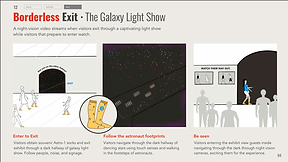
Exit Experiences


Presentation
Once we completed our storyboards and designed our presentation, we presented via Zoom to our stakeholders which included five NASA scientists who participated in the Astro-1 mission, university department chairs, and other interested parties. My role in the presentation was to creating an engaging introduction by introducing the story behind Astro-1, prepare the audience to experience the various storyboards, and host a Q&A at the end of the presentation.

.jpg)
.jpg)
Stakeholder Feedback
Richard Hamner, NASA Scientist
"The presentation was exceptionally well done. I think you should watch your phone for a call from the Smithsonian soon."
Next Steps

Review
-
Obtain additional feedback on current storyboards
-
Refine and update

Commit
-
Project leads work with NASA members and Smithsonian curators to identify and finalize future actions

Develop
-
Establish a research and development team to refine and iterate on the exhibit design